

Description
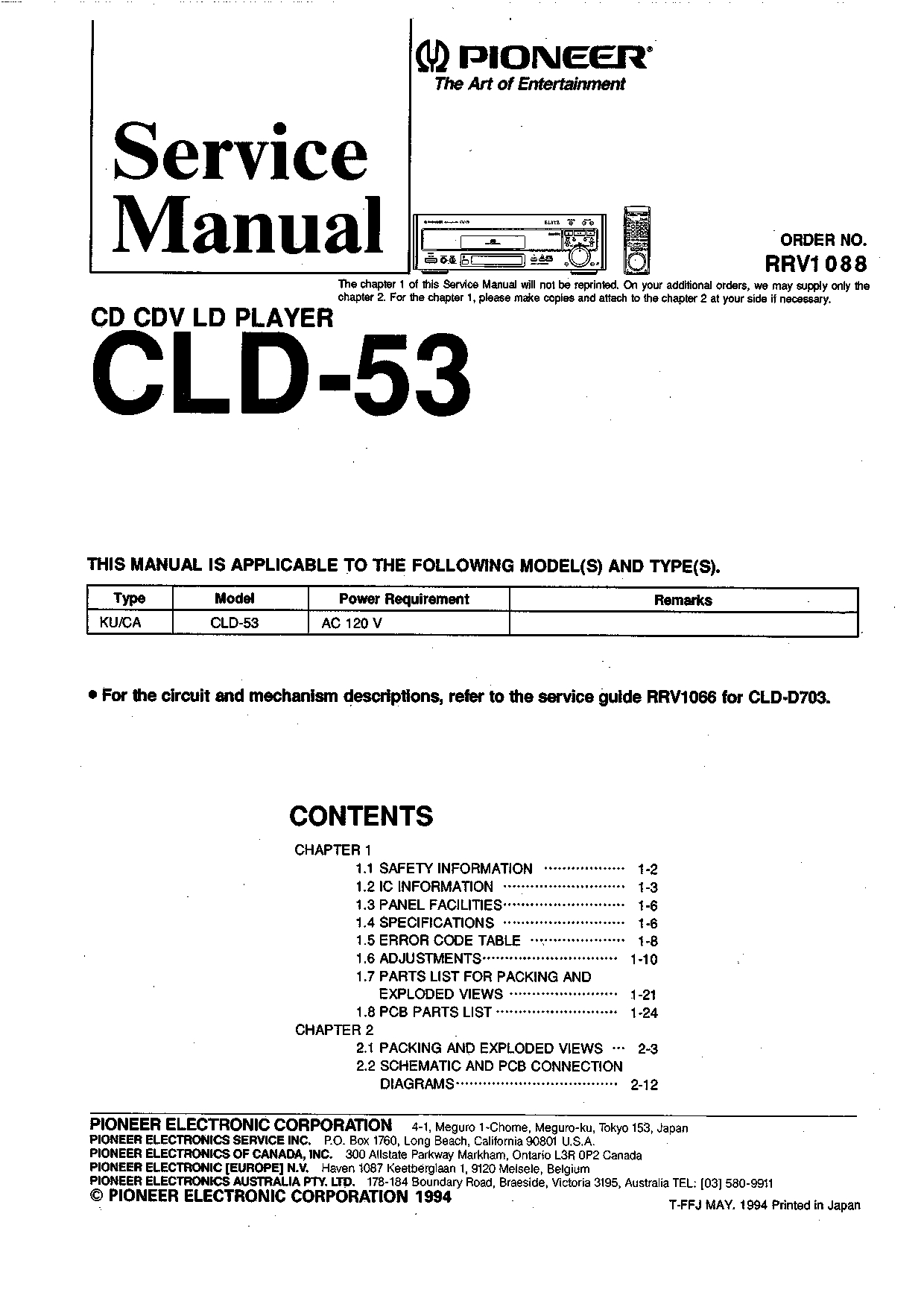
This Pioneer Service Manual, bearing Order No. RRV1088, is the definitive technical resource for the CLD-53 CD CDV LD Player. The CLD-53 is a sophisticated multi-format player capable of handling Compact Disc (CD), Compact Disc Video (CDV), and LaserDisc (LD) media, offering a versatile home entertainment solution during its production era. The manual is explicitly intended for qualified service technicians and is not meant for the casual do-it-yourselfer. It serves as a necessary blueprint for performing proper service, adjustments, and repairs, providing all the critical information needed to restore the product to its original safety and reliability standards. The manual underscores the importance of safety, including warnings about the hazards of working with electronic devices and the handling of lead solder, which contains chemicals known to the state of California to cause cancer and birth defects or other reproductive harm. Furthermore, it details specific safety checks, such as the AC Leakage Test, which must be performed on all exposed metal surfaces of the device (chassis, metal overlays, control shafts, etc.) to ensure that current leakage from the AC line cord does not exceed $0.5 \text{ mA}$ when the appliance is plugged into a $120\text{V AC }60\text{Hz}$ outlet. This emphasis on stringent safety procedures highlights Pioneer’s commitment to consumer protection and ensures that any serviced unit maintains its original safety characteristics. The manual also notes that any replacement electrical or mechanical parts must be the original Pioneer-recommended components, as outlined in the parts lists section, to guarantee the continued safety and reliability of the player. Substitution with unapproved components may compromise the product’s safety features and could void the warranty. The CLD-53 model covered is the KU/CA type, designed for AC $120\text{ V}$ power requirement. The comprehensive nature of the document, which includes detailed IC information, parts lists, and later sections on schematics and exploded views (referenced in the Table of Contents), ensures that a technician has all the necessary reference material for troubleshooting and repair, from the component level to the overall mechanism control. This level of detail makes the manual an invaluable resource for the long-term maintenance and preservation of this classic Pioneer multi-format player.
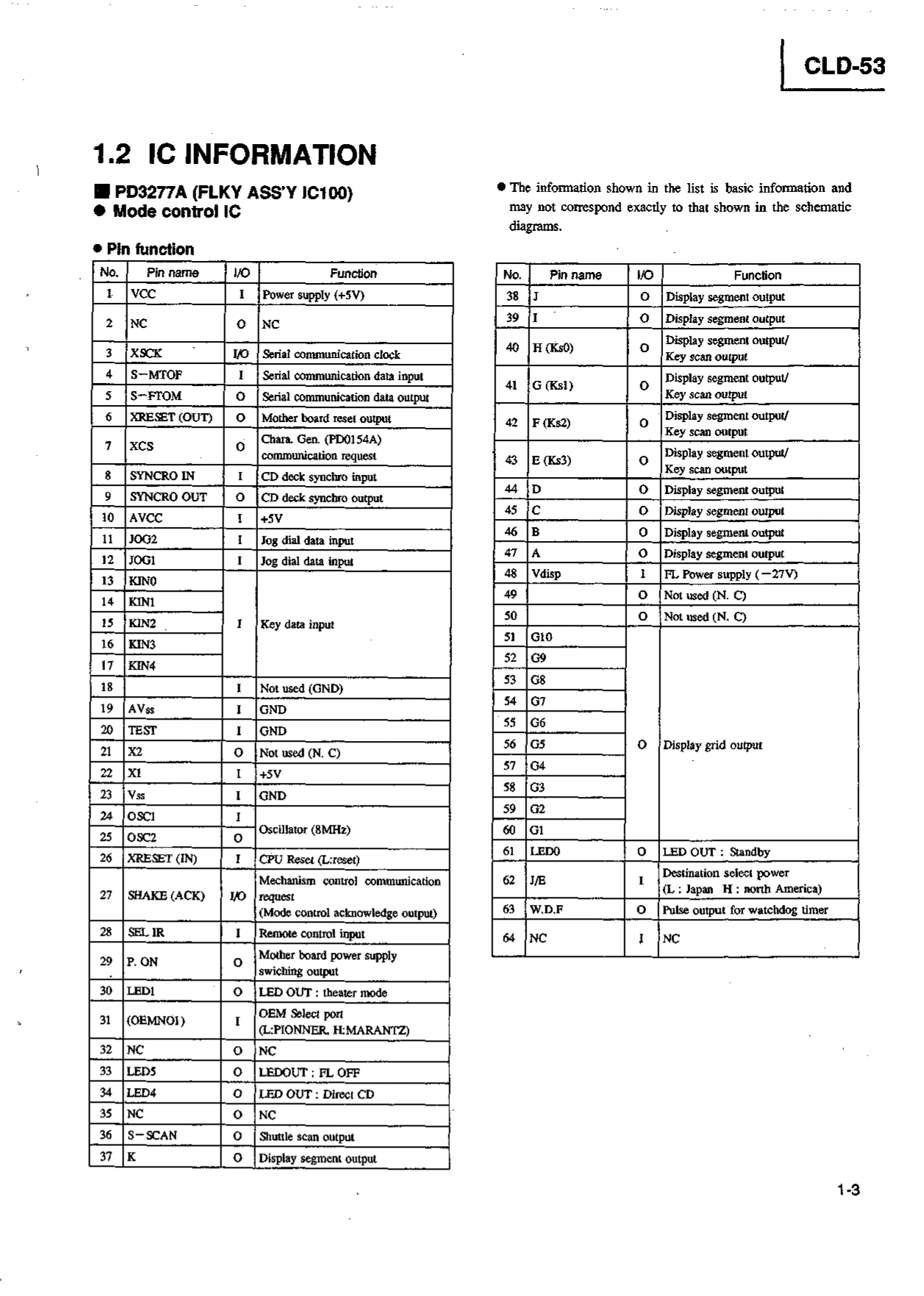
The IC Information section, in particular, provides a microscopic look at the device’s control system, detailing the pin assignments, I/O classification, and function for key integrated circuits, such as the PD9277A (FLKY ASS’Y IC100) Mode control IC. This is crucial for diagnostics, allowing technicians to trace signals and power supplies at the core of the player’s operation. For instance, the table lists 64 pins, detailing functions ranging from VCC (Power supply) and various Ground (GND) connections to specific control, data, and output lines. Examples of these functions include XRCK (I/O serial communication clock), S-MTDF (Serial communication data input), LED1 (O/ED OUT: Lower mode), and display segment outputs like A, B, C, D, E (Ka3), F (Ka2), G (Ka1). The inclusion of these highly specific technical details confirms the manual’s role as a primary reference for complex electronic repair, far exceeding the scope of a typical user manual. The functions also reveal the device’s operational complexity, which includes CD deck synchro input (SYNCRO IN), CD deck synchro output (SYNCRO OUT), JOG1/JOG2 (Avg dial data input), KINO/KIN1/KIN2/KIN3 (Key data input), and control signals for the LaserDisc mechanism like SHAKE (ACK) (Mechanism control communication request/acknowledge output). This intricate mapping of the IC’s interfaces is the cornerstone for understanding the flow of control and data within the CLD-53, which is essential for diagnosing faults that may not be immediately obvious. The Safety Information section further outlines the importance of careful and correct servicing, noting that the content of the manual must be interpreted in conjunction with other Pioneer Service information, such as updates, revisions, and new instructions concerning product safety. This continuous commitment to technical accuracy and safety standards ensures that all repairs maintain the product’s integrity. The manual, therefore, is not merely a descriptive document but a vital tool for maintaining the high-quality performance and safety standards of the Pioneer CLD-53.
The comprehensive nature of the manual extends beyond circuit-level details to cover the mechanical and structural aspects of the player. Although the provided excerpts do not show the actual schematics or exploded views, the Table of Contents confirms their inclusion in the full document. Sections like “Schematic and PCB Connection Diagrams” and “Packing and Exploded Views” are indispensable for physical repair, allowing technicians to correctly disassemble, repair, and reassemble the unit. The exploded views would detail the arrangement of all mechanical parts, including the CD/CDV/LD mechanism, the loading tray, and the chassis components, aiding in the replacement of broken or worn parts. The schematics, on the other hand, provide the complete electrical map, showing the interconnection of all components, power supplies, and signal paths, which is the ultimate tool for advanced circuit-level troubleshooting. This holistic approach, covering electronics, safety, mechanical assembly, and parts enumeration, defines the manual as an exhaustive service resource. The goal is to provide a single source of truth for all service-related activities, minimizing guesswork and ensuring that all repairs are executed precisely according to the manufacturer’s specifications. For the CLD-53, a device that combines delicate laser optics, complex motor control, and intricate digital and analog audio/video circuitry, such a detailed manual is critically important for its long-term operability. The availability of this material as an INSTANT DOWNLOAD ensures that service personnel can quickly access the necessary information, reducing repair times and enhancing the service efficiency for owners of this classic Pioneer player.