
Description
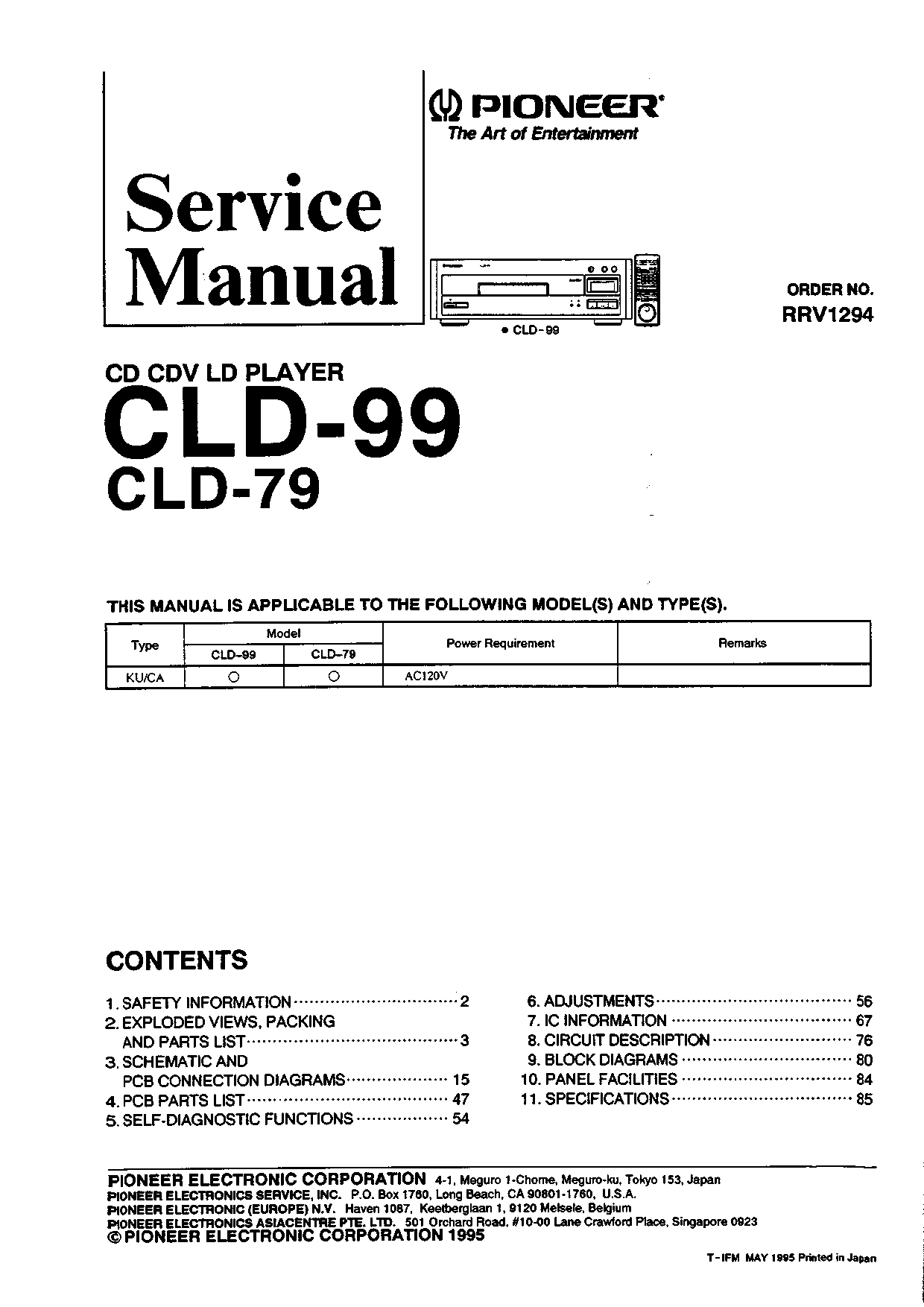
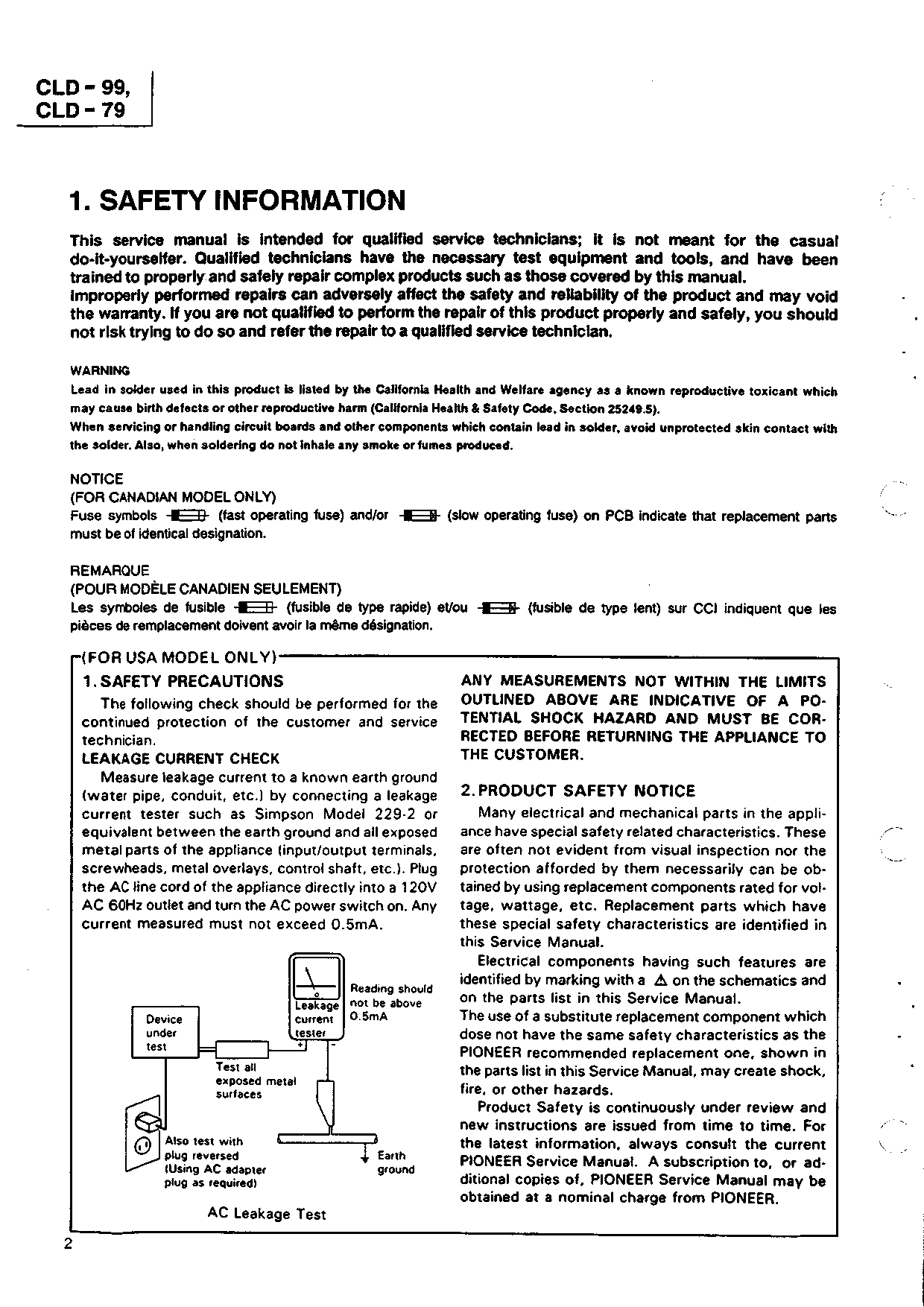
This Pioneer Service Manual, bearing Order No. RRV1294, is the comprehensive technical guide covering the CLD-99 and CLD-79 CD CDV LD Players. These models represent Pioneer’s high-performance line of multi-format players, capable of handling Compact Disc (CD), Compact Disc Video (CDV), and LaserDisc (LD) media. The manual is explicitly an industrial document, strictly intended for qualified service technicians and not for the casual consumer or “do-it-yourselfer.” The CLD-99 and CLD-79 models covered are of the KU/CA Type, designed to operate on AC $120\text{V}$ power supply. The manual serves as the essential blueprint for performing all necessary services, adjustments, and repairs, ensuring that the players are restored to their original factory safety and reliability specifications. This is crucial for high-end electronics like these players, which incorporate complex laser mechanisms, intricate motor control systems, and advanced digital and analog circuitry for superior audio and video output. The document begins with a stringent Safety Information section, a non-negotiable component of any technical service manual, which includes a clear WARNING about the dangers of lead solder, which is recognized by health agencies to contain known reproductive toxicants. This emphasizes that servicing must be performed in a safe, controlled environment by trained personnel who understand the associated risks. A key safety requirement detailed is the mandatory AC Leakage Test, a procedure that technicians must follow after every repair that involves the electrical circuit. This test checks for current leakage from the AC line cord to all exposed metal surfaces of the player, and the current must not exceed $0.5 \text{ mA}$ under any condition, reinforcing Pioneer’s priority on customer safety. The manual’s scope is massive, covering everything from the lowest-level component parts lists (PCBs) to the highest-level functional and architectural diagrams (Block Diagrams and Schematics). This comprehensive structure positions the manual as the single authoritative source for deep-level diagnostics, component replacement, and system-level calibration for both the CLD-99 and CLD-79 players.
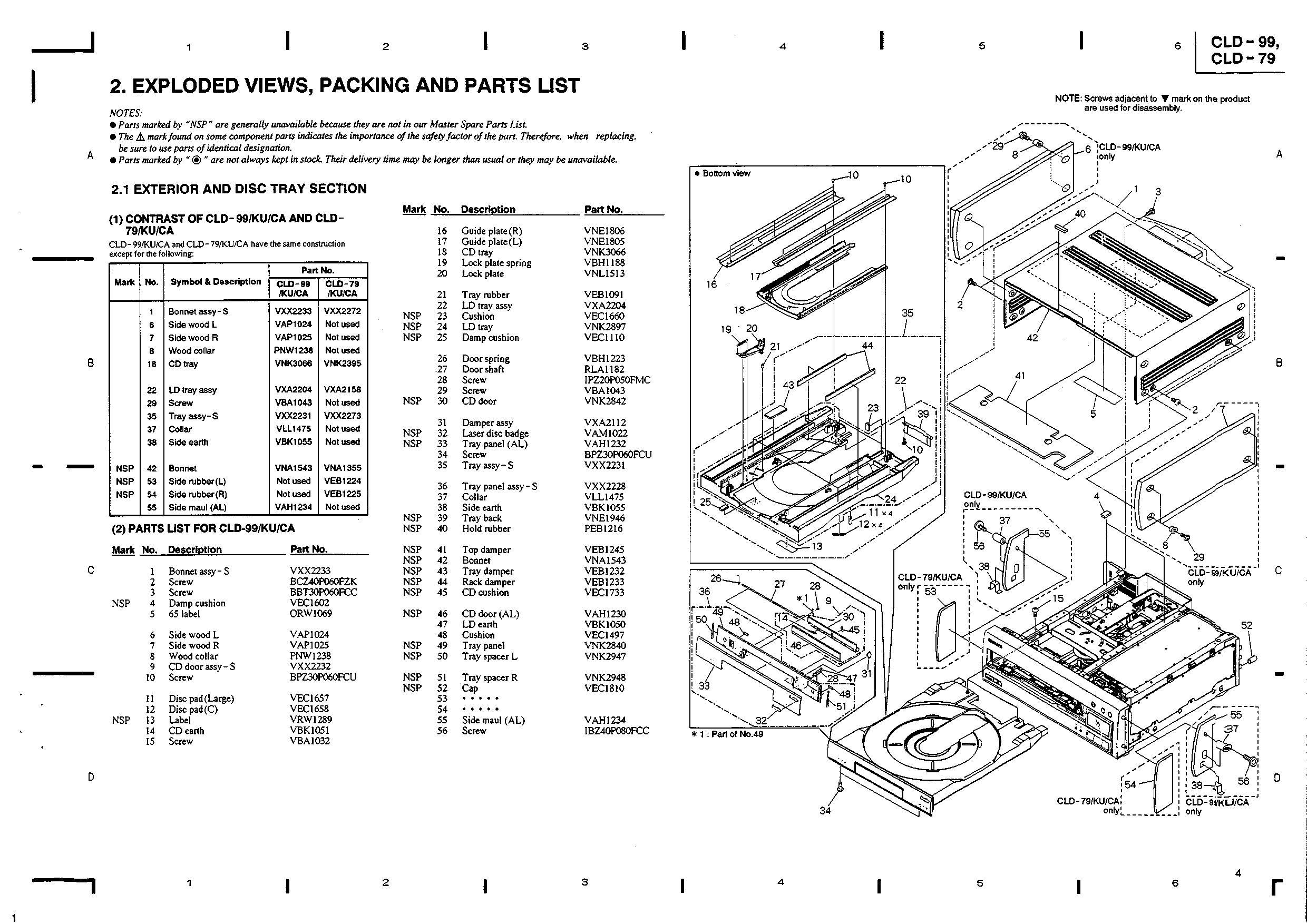
The manual delves into extraordinary technical depth across its ten main sections, providing the granular detail necessary for professional service. The inclusion of parts lists and exploded views is fundamental for the physical repair and maintenance of the mechanical sections. The Exploded Views, Packing, and Parts List section, for example, illustrates the entire exterior and disc tray section, breaking down the complex mechanisms into individual, identifiable components. The table for the Contrast of CLD-99KU/CA and CLD-79KU/CA explicitly notes differences in part numbers between the two models for specific components like the front panel, side wood (right and left), and the wood collar, demonstrating the manual’s utility in servicing both closely related units. Components like the Guide plate, Disc holder, Lock plate, Door shaft, and various Tray parts are listed with their specific part numbers, enabling precise ordering of replacement spares. This level of detail is vital for the correct reassembly and functioning of the disc loading and playback mechanism, which often involves sensitive alignment. Furthermore, the manual progresses into the electrical heart of the players, with sections dedicated to IC Information, Circuit Description, and Block Diagrams. The IC Information section is essential for signal tracing and power supply diagnostics at the semiconductor level, while the Block Diagrams provide an architectural overview of the player’s various functional stages (e.g., video processing, audio signal path, system control), which is the first step in high-level troubleshooting. The logical flow from mechanical breakdown to electrical architecture ensures that a technician can approach any repair, whether a simple part replacement or a complex circuit fault, with the highest degree of efficiency and accuracy.