Description
This Service Manual for the Yamaha APD-1 Dolby Digital RF Demodulator is an essential technical resource for authorized Yamaha retailers and service personnel. Available for instant download, it provides an unparalleled depth of information crucial for the maintenance, troubleshooting, and repair of this specialized audio component. The APD-1’s primary function, as a Dolby Digital RF Demodulator, is to convert the RF (Radio Frequency) signal from Laserdisc players, specifically those with a Dolby Digital AC-3 RF output, into a usable digital audio signal for compatible AV receivers or processors. This manual goes far beyond a user’s guide, delving into the intricate electrical and mechanical aspects of the device, making it indispensable for anyone performing technical work on the unit. The manual’s core purpose is to facilitate component-level repair and accurate diagnosis. It achieves this by providing detailed schematic diagrams that illustrate the complete electrical circuitry of the APD-1. These schematics are not merely visual aids; they are precise engineering drawings that show every component, connection, voltage point, and signal path, allowing technicians to meticulously trace signals and identify where a fault might occur. This level of detail is critical for pinpointing issues like short circuits, open circuits, or component failures. Complementing the schematics are IC block diagrams, which provide a higher-level, functional view of the integrated circuits used within the APD-1. These diagrams help in understanding the role of each major chip in the demodulation and digital signal processing chain, without overwhelming the technician with excessive detail at the initial diagnostic stage. By understanding the functional blocks, a technician can narrow down the problematic area before consulting the full schematics. Furthermore, the manual includes printed circuit board (PCB) layouts, which are invaluable for identifying component locations on the physical boards. These layouts often show component designators (e.g., R101, C205) corresponding to those in the schematics, making it easy to locate and test specific parts. This visual guide is crucial for efficient troubleshooting and component replacement, especially in densely packed electronic assemblies. The emphasis on detailed technical documentation ensures that authorized service personnel have all the necessary information to perform precise and effective repairs, maintaining the high quality and performance for which Yamaha is known. The manual also serves as a critical reference for understanding the inherent complexities of the APD-1, enabling a thorough comprehension of its internal workings and signal flow, thus ensuring optimal service and longevity of the device.
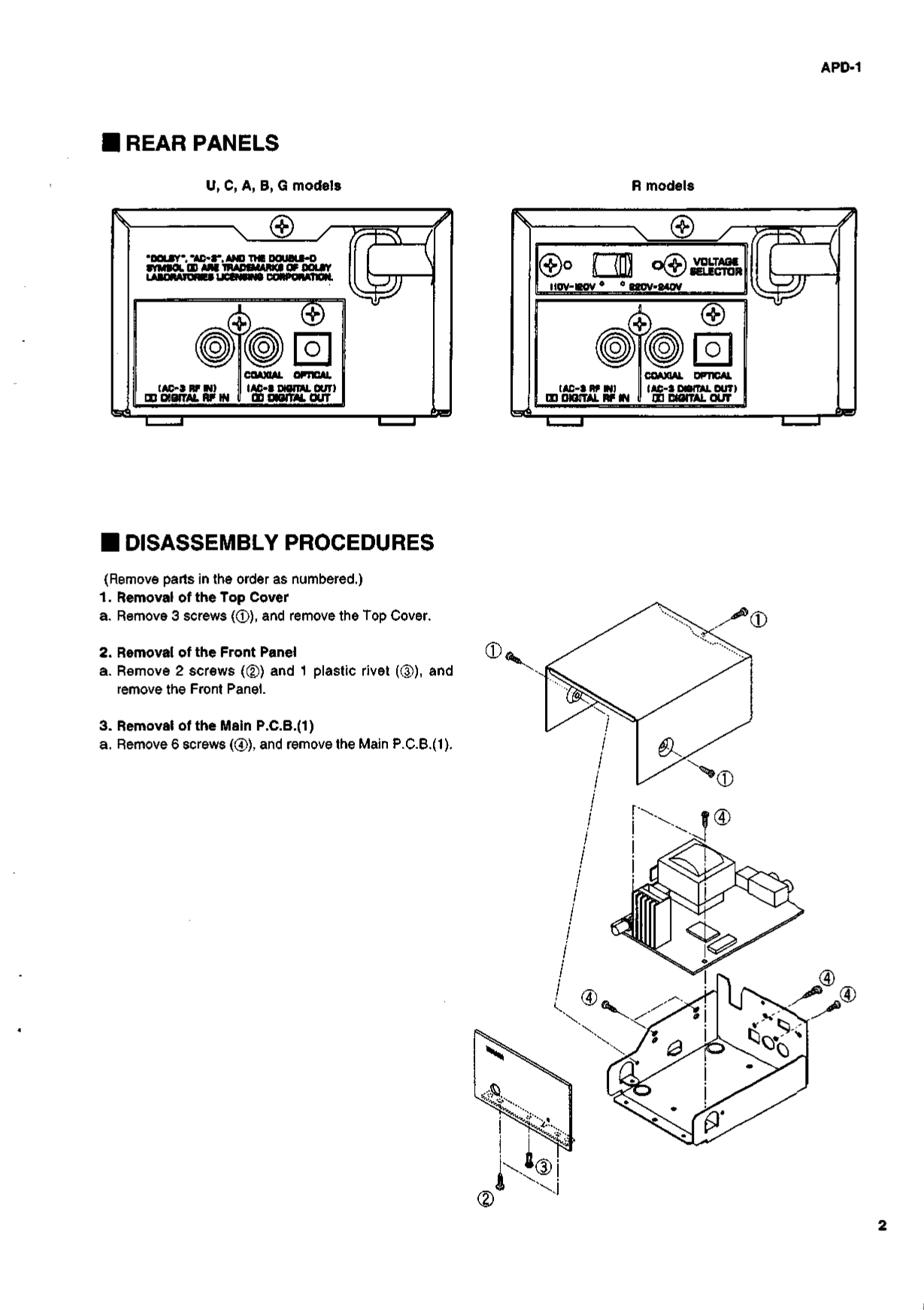
The Yamaha APD-1 Service Manual offers comprehensive instructions that extend to the practical aspects of servicing, including meticulous disassembly procedures and a complete parts list. The disassembly procedures are crucial for safely accessing the internal components of the APD-1 without causing further damage to the unit. These sections typically include step-by-step instructions, often accompanied by exploded diagrams that visually illustrate how various parts fit together and in what order they should be removed. This ensures that technicians can systematically take apart the unit to reach specific circuit boards or components, whether for inspection, repair, or replacement. Proper reassembly is equally emphasized, ensuring that the unit is put back together correctly, all connectors are securely fastened, and the physical integrity of the device is maintained. The parts list is another cornerstone of this service manual, providing a comprehensive inventory of every component within the APD-1. This list typically includes unique part numbers, descriptions, and sometimes even specifications for each component, from major circuit boards and power transformers down to individual resistors, capacitors, and screws. The inclusion of part numbers is vital for ordering exact replacements from Yamaha or authorized distributors, ensuring that repairs use genuine components that meet the manufacturer’s specifications. This not only guarantees the repaired unit’s performance but also its reliability and safety. Beyond the structural and component-level details, the manual features crucial safety precautions and warnings specifically tailored for service personnel. Unlike a user manual, these warnings are often more technical, addressing risks inherent to internal servicing, such as high voltages within the unit or static electricity discharge (ESD) that can damage sensitive electronic components. The manual explicitly states that servicing procedures should only be performed by authorized and trained personnel, due to the potential for electric shock and other hazards. It also highlights the importance of using proper tools and following established safety protocols to prevent injury to the technician and damage to the equipment. This includes specific warnings about handling electrostatic sensitive components, which are crucial for preserving the integrity of integrated circuits and other delicate parts. The manual’s robust approach to safety for service personnel underscores the complexities of working with electronic devices and emphasizes the need for professional expertise. By providing such detailed instructions for disassembly, comprehensive parts lists, and stringent safety guidelines, the Yamaha APD-1 Service Manual becomes an indispensable tool for maintaining the high standards of performance and reliability expected from Yamaha products, ensuring that the APD-1 continues to function optimally throughout its lifespan.
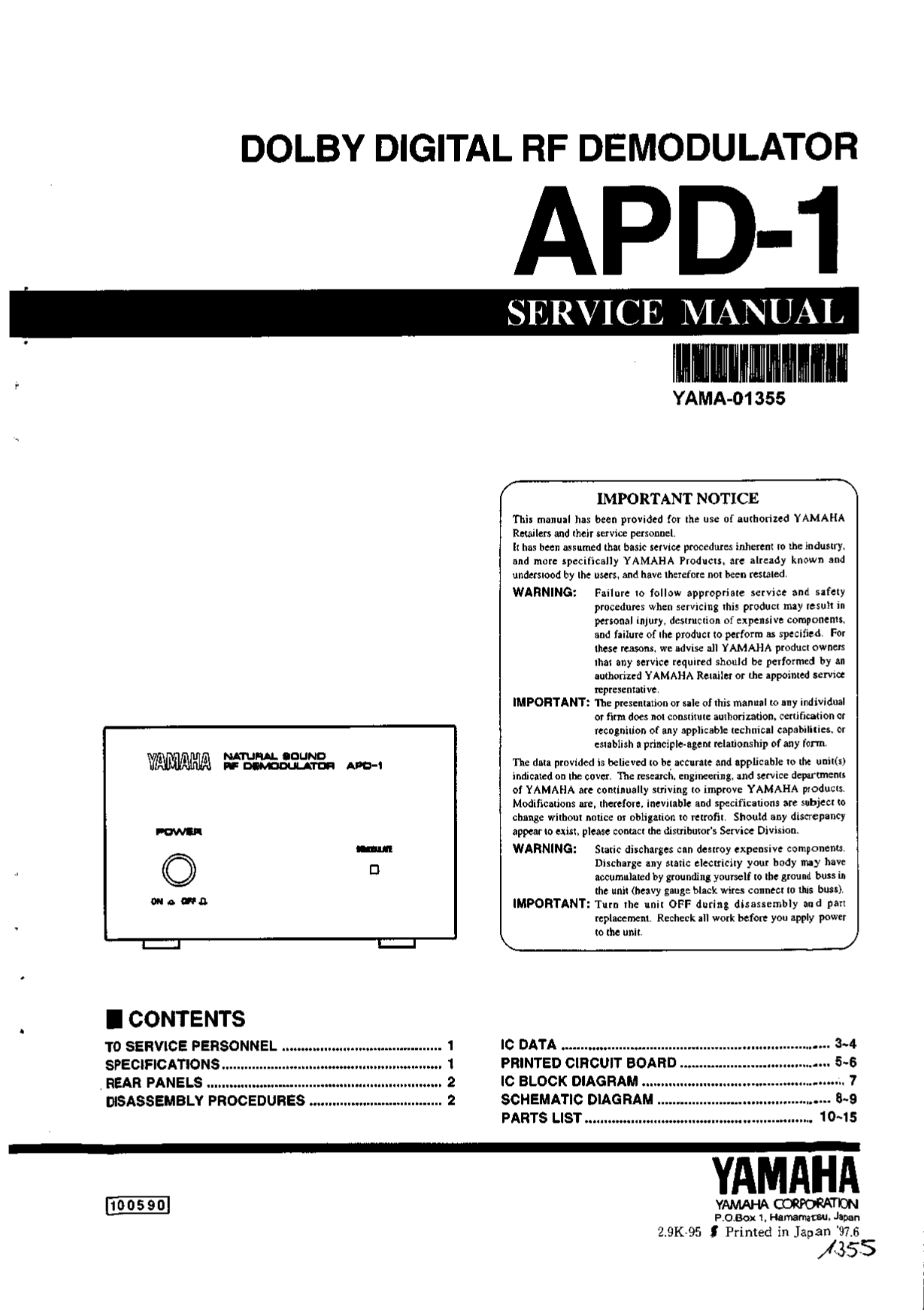
This Yamaha APD-1 Dolby Digital RF Demodulator Service Manual, available for instant download, is more than just a repair guide; it is a vital document for ensuring the sustained performance and longevity of this specialized audio component. Its significance lies in its direct address to authorized Yamaha Retailers and their service personnel, explicitly stating that the manual’s content is intended for their exclusive use. This exclusivity underscores the technical depth and sensitive information contained within, differentiating it from public-facing user manuals. The manual begins with crucial IMPORTANT NOTICES that set the tone for responsible servicing. It explicitly states that “this manual has been prepared for the use of authorized YAMAHA Retailers and their service personnel.” This initial statement reinforces the professional context of the document. A key WARNING highlights the potential for personal injury and damage to the product if servicing procedures are not followed correctly, emphasizing that “failure to follow appropriate service and safety procedures when servicing this product may result in personal injury, damage to or destruction of product and failure of the product to perform as specified.” This stern warning reinforces the necessity of proper training and adherence to outlined procedures. Furthermore, it clarifies that “any service required should be performed by an authorized YAMAHA Retailer or other qualified service representative.” This protects both the technician and the integrity of the product. Another IMPORTANT NOTICE addresses firmware and design modifications, stating that “modifications are, therefore, inevitable and specifications are subject to change without notice.” This informs service personnel that they must stay updated with any revisions or bulletins from Yamaha regarding the APD-1, ensuring that they use the most current information for repairs and adjustments. This proactive approach helps maintain consistency in service quality across the network. A significant WARNING within the manual relates to static electricity discharges (ESD). It explicitly states, “static discharges can destroy or degrade sensitive components. Disconnect the static electricity your body may have accumulated by grounding yourself to the ground terminal of the unit (the large black screw connect to the bus).” This crucial instruction highlights the vulnerability of the APD-1’s electronic components to static damage, providing a direct, actionable step for prevention. This is especially important when handling sensitive integrated circuits and microprocessors that are at the heart of the demodulator’s functionality. Lastly, an IMPORTANT NOTICE details the critical step of turning OFF power and disconnecting the AC plug before any disassembly or repair work. It mandates, “turn the unit OFF using [POWER] switch and pull out the AC plug, before all work you apply yourselves to the unit.” This fundamental safety protocol is reiterated to prevent electric shock and ensure the safety of the technician performing the service. The combination of these specific warnings, technical diagrams, and comprehensive parts lists makes this service manual an indispensable resource, ensuring that the Yamaha APD-1 Dolby Digital RF Demodulator can be effectively maintained and repaired by qualified professionals, extending its operational life and ensuring it continues to deliver high-quality digital audio for Laserdisc enthusiasts.